


Xi'an Kintai Biotech Inc is one of the most experienced manufacturers and suppliers of tansy extract in China. Please feel free to wholesale high quality tansy extract for sale here from our factory. For price consultation, contact us.
1.Product Introduction
Tansy Extract produced by KINTAI is extracted from Tanacetum vulgare L. (Chrysanthemum vulgare (L.) ), commonly known as tansy, which is a species of the genus Chrysanthemum in the family Asteraceae. Some members of this genus are very important species as they have been used worldwide for many years for their medicinal properties.
T. vulgare extract mainly includes chlorogenic acid, hyperoside, isoquercitrin,rutin, quercitrin, quercetin, patuletin, luteolin, apigenin.,etc. T. vulgare also contains a variety of bioactive metabolites, mainly sesquiterpene lactones, essential oils, phenolics and polysaccharides. Tansy is used to treat wounds, headaches, fevers, liver diseases and gastrointestinal , rheumatic pains and intestinal parasites.

Tanacetum vulgare L.

Tansy herbs

Tansy supplement

Tansy extract
2. Plant Source
Artemisia chrysanthemum (scientific name: Tanacetum vulgare L.) is a plant of the genus Artemisia chrysanthemum of the Asteraceae family. Perennial herb, 30-150 cm tall. Stem erect, solitary or a few stems in clusters, only the upper part branched, with very sparse simple hairs, but usually smooth and glabrous. Numerous stems and leaves, solid elliptical or elliptical-ovate.
The leaves are all green or light green, very sparsely hairy or nearly glabrous. Most of the flower heads (10-20) are arranged in dense corymbs or compound corymbs at the top of the stems. Involucre diameter 5-13 mm. Involucreous bracts 3-layered, herbaceous. The outer layer is oval-lanceolate, about 1.5 mm long, and the middle inner layer is lanceolate or oblong, 3-4 mm long. Achenes 1.2 to 2 mm long. The crown hairs are 0.1 to 0.4 mm long and the crown margin is slightly toothed. The flowering and fruiting period extends from June to August.

Native to eastern and central Europe to temperate Asia; distributed in all European countries except the Mediterranean islands and Greenland. Distribution in Asia is limited to northern regions, including Russia, northern provinces of China (Heilongjiang and Xinjiang), Mongolia, Japan, North Korea and South Korea. It has been introduced to Argentina, Australia, Canada, Chile, Guadeloupe, Martinique, New Zealand, Peru and the United States. Born in hillsides, river beaches, meadows, hills and birch forests at an altitude of 250-2400 meters.
Stems and flower heads contain insecticidal substances, which can treat cholestasis, jaundice, etc., and can also be used as insecticides. The flowers are bright in color, unique in shape, and have a long blooming time. They can be used to green flower beds and borders in autumn, and can also be used as cut flowers.
3.Product quality specification & standard
|
Product name |
Tansy Extract |
|
Extract source |
Tanacetum vulgare L. |
|
Extraction Solvent |
Ethyl alcohol |
|
Appearance |
Fine Brown Yellow Powder |
|
Solubility |
Dissolved in water |
|
Identification |
UV |
|
Sulphated Ash |
NMT 0.5% |
|
Heavy metals |
NMT 20 PPM |
|
Loss On Drying |
NMT 5.0% |
|
Powder size |
80Mesh, NLT90% |
|
Assay (HPLC test, percent, Standard in House) |
Min. 95.0% |
|
Residual Solvents |
|
|
- N-hexane |
NMT 290 PPM |
|
- Methanol |
NMT 3000 PPM |
|
- Acetone |
NMT 5000 PPM |
|
- Ethyl Acetate |
NMT 5000 PPM |
|
- Ethanol |
NMT 5000 PPM |
|
Pesticide Residues |
|
|
- Total DDT (Sum of p,p'-DDD,P,P'-DDE,o,p'-DDT and p,p' -DDT) |
NMT 0.05 PPM |
|
- Aldrin, Endrin, Dieldrin |
NMT 0.01 PPM |
|
Microbiological Quality (Total viable aerobic count) |
|
|
- Bacteria, CFU/g, not more than |
NMT 10³ |
|
- Moulds and yeasts, CFU/g, not more than |
NMT 10² |
|
- E.coli, Salmonella, S. aureus, CFU/g |
Absence |
|
Storage |
In Tight, Light-resistant and Dry Place. Avoid Direct Sunshine. |
|
Shelf life |
24 months |
4.KINATI's Extraction Processing

5.HPLC chromatogram

Fig1.HPLC chromatogram of T. vulgare extract : The identified compounds: 1, Chlorogenic acid; 2, Hyperoside; 3, Isoquercitrin; 4, Rutin; 5, Quercitrin; 6, Quercetin; 7, Patuletin; 8, Luteolin; 9, Apigenin

Fig2.Polyphenolic compounds content in T. vulgare extracts (µg/g plant)
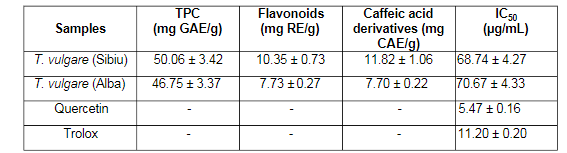
Fig3.Total phenols and the results of DPPH method for Tanacetum extracts

Fig4.Results of the antimicrobial activity of T. vulgare extracts
6.Benefits and Application
Benenfits
6.1. Sedation
It has sedative properties, and some radiologists have mixed blue tansy essential oil with water in a spray bottle to help treat skin burns sometimes caused by cancer radiation therapy.
6.2. Anti-inflammatory properties
Studies have shown that hinokitiene is a powerful anti-inflammatory agent, the main ingredient in tansy, which reduces inflammation in the body.
Additionally, chamazulene, the chemical that gives the oil its blue color, is also an anti-inflammatory agent, notes the American Chemical Society.

6.3. Skin Repair
The concentration of camphor in tansy oil has been shown to help repair damaged skin.
In the study, mice exposed to UV light showed improved conditions after being treated with camphor.This led researchers to speculate that camphor might be an effective wound healing agent and even an anti-wrinkle agent.
6.4. Antihistamine properties
In traditional Chinese medicine,tansy is used as an antihistamine to reduce nasal congestion.

Application
Tansy Extract is mainly used in drug therapy for lung heat cough.
7.What can KINTAI do?


8.KINTAI'S PROCESSING

9.Why choose Kintai?

10.Kintai manufacturing base

11.Kintai R&D center

12.Package

TIPS
If you want to purchase high-quality Tansy Extract, please feel free to contact us at sales@kintaibio.com or feedback on the next page.
Hot Tags: Tansy Extract, China Tansy Extract manufacturers, suppliers, factory, Kelp Extract Powder, Boswellia Serrata Extract Powder, Hops Flower Extract Powder, Pinocembrin, Greater celandine extract, Pure L-Theanine Powder