

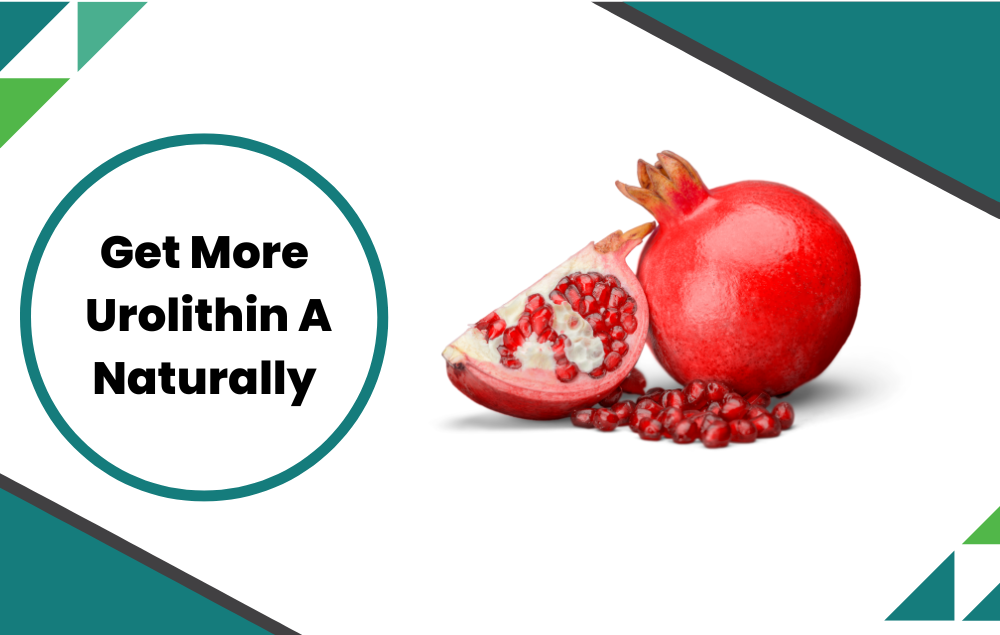
Ellagitannins (ETs) found in pomegranates can be metabolized by gut microbiota into Urolithin A (UA) powder, a process confirmed by numerous studies. UA activates mitochondrial autophagy, improving muscle function, slowing aging, and boosting immunity. The global Urolithin A market is expected to reach $56 million by 2030, with dietary supplements accounting for over 60% of the market. As a natural precursor of UA, the actual UA production from pomegranate is influenced by individual differences in gut microbiota and metabolic efficiency. Thus, we analyze this ingredient further to drive the widespread application of Urolithin A Powder.

Urolithin A Precursors in Pomegranate: Content and Metabolic Pathways
The biosynthesis of UA in pomegranates depends on its high content of Ellagitannins (ETs) and Ellagic Acid (EA). Studies show that pomegranate peel, membrane, and juice are rich in ETs, with concentrations in the peel reaching 20-25% of dry weight. Once consumed, Ellagitannins are hydrolyzed to Ellagic Acid in the gut, which is then converted by specific gut bacteria (e.g., Gordonibacter and Bifidobacterium) into intermediate metabolites (such as Urolithin E, M-6), eventually yielding UA.
Source: Layer Origin Nutrition
Efficiency and Limitations of Pomegranate Conversion to Urolithin A
Although pomegranate is a major natural source of UA precursors, the actual conversion to Urolithin A Powder is influenced by several factors:
- Individual Variability: Around 40% of people are unable to efficiently metabolize Ellagic Acid into UA due to the lack of specific gut bacteria (e.g., Gordonibacter), a group referred to as "non-producers" (Metabotype 0). Conversion efficiency also declines with age.

- Consumption Requirements: Clinical studies suggest that about 1,000 mg of Ellagic Acid (equivalent to 5 cups of pomegranate juice) is needed to produce an effective dose of UA (500 mg). However, consuming pomegranate alone is insufficient to reach this amount.
- In Vitro Digestive Studies: After digestion, pomegranate extract shows a significant increase in total phenols (from 232 to 1,656 mg GAE/g), but its antioxidant capacity decreases, which may impact metabolic efficiency. Furthermore, inactive metabolites such as Urolithins B, C, and D may be produced, potentially increasing the risk of cardiovascular disease.
Enhancing Urolithin A Powder Production
- Gut Microbiota Regulation: For individuals consuming pomegranates, we recommend supplementing with probiotics (such as Bifidobacterium pseudocatenulatum) to enhance the conversion of Ellagic Acid to UA.
- Supplement Manufacturing: We suggest using standardized pomegranate extracts (e.g., containing 40% Ellagitannins) combined with liposome encapsulation technology to improve absorption efficiency.
- Direct UA Supplementation: Direct supplementation with Urolithin A Powder can bypass the microbiota limitations, offering up to 6 times higher plasma exposure compared to dietary intake.
Applications and Market Considerations
Dietary Supplement Development: Due to the low conversion rate of natural pomegranate to UA, the market is shifting toward high-purity Urolithin A supplements. Clinical trials show that a 500 mg daily dose enhances muscle endurance and mitochondrial function.

Functional Food Innovation: Combining pomegranate extract with probiotics (e.g., formulas containing Akkermansia muciniphila) can target and increase the abundance of Urolithin A -producing bacteria.
Kintaibio® Urolithin A Powder uses industrial-scale fermentation technology to overcome the limitations of natural intake, offering the health industry a high-purity, standardized solution.

Why Choose Kintaibio® Urolithin A?
Purity ≥98%: HPLC testing ensures consistent quality with each batch, avoiding the uncertainty of natural intake.
Production Process: KINTAIBIO® uses fermentation technology to replace chemical synthesis, eliminating traditional impurities, leading to industry-leading purity (compared to some competitors at 98%).
Guaranteed Efficacy:
- Mitochondrial Activation: Activates autophagy pathways, clearing senescent cells and enhancing muscle endurance (40% increase in endurance in aged mice).
- Immune Boost: Restores hematopoietic stem cell function in the elderly and improves T-cell antiviral response.
- Versatile Applications: Suitable for anti-aging supplements, sports nutrition products, and skincare formulas (clinical trials show that adding 0.5%-1% can improve skin collagen).
Production System: 100,000-class GMP facilities with an annual capacity of 30 tons to meet global demand.
R&D Support: A 600 m² lab provides formula adaptation, stability testing, and customized development services. We offer specialized formulas in areas such as anti-aging, sports recovery, and metabolic health.
International Certifications: GMP, ISO9001, ISO 22000, and Halal certifications.
Feel free to contact us at sales@kintaibio.com with any questions.
FAQ
Q: Does pomegranate contain Urolithin A?
A: Strictly speaking, pomegranates are not a primary direct dietary source of Urolithin A, but rather a significant source of its precursors. During digestion, the ellagitannins found in pomegranates release ellagic acid, which is subsequently converted by specific gut microbiota into various urolithins, including Urolithin A. Studies have detected urolithin metabolites in humans following the consumption of pomegranate juice or related products, demonstrating that the polyphenol precursors in pomegranates can enter this metabolic pathway.
Q: Is Urolithin A safe during pregnancy?
A: There is currently insufficient high-quality clinical data on humans to confirm the safety of Urolithin A during pregnancy and breastfeeding. Therefore, it is not recommended to market Urolithin A for use by pregnant women. Pregnant or breastfeeding women should consult a healthcare professional to determine whether to use it.
Q: What is the difference between natural Urolithin A and Urolithin A powder?
A: Naturally, the human body converts ellagitannins and ellagic acid into Urolithin A via gut microbiota; however, due to individual differences in gut flora, not everyone produces the same levels of Urolithin A. Direct supplementation with Urolithin A powder bypasses the body's need to perform this conversion, making it easier to standardize dosages and design formulations for functional foods and dietary supplements.
Q: Is pomegranate extract the same as Urolithin A?
A: No. Pomegranate extract typically focuses on plant-derived polyphenols such as ellagitannins, punicalagins, and ellagic acid as its key components, whereas Urolithin A powder is a raw material containing standardized levels of Urolithin A produced through specific manufacturing processes. Thus, pomegranate extract serves as a precursor source for Urolithin A, while Urolithin A powder provides Urolithin A directly.