

In recent years, plant-derived active ingredients for oral care have garnered increasing attention. Beyond traditional agents-such as fluoride, calcium-phosphate minerals, and conventional antimicrobials-researchers are actively seeking natural plant-based materials capable of inhibiting bacterial growth and tooth demineralization, as well as supporting the repair of dental hard tissues. Galla chinensis (Chinese nutgall) is one such plant-derived material that has become a subject of significant research interest.


Research into Galla chinensis regarding dental health focuses primarily on two areas: first, its constituents-such as tannins and polyphenols-may influence cariogenic biofilms and their acid-production processes; second, it may affect mineral deposition and tissue structure on the surfaces of dental enamel and dentin. Existing studies have largely concentrated on the effects of Galla chinensis extract on dental hard tissues and the oral microbial environment. These effects include the inhibition of specific cariogenic bacteria and dental plaque biofilm activity, the reduction of enamel demineralization, the modulation of remineralization processes in early-stage carious lesions, and impacts on dentin structure and dentinal tubules.
KINTAIBIO® is a specialized manufacturer of Galla chinensis extract powder; our products are characterized by high activity, superior quality, and batch-to-batch consistency. We invite you to contact us at sales@kintaibio.com for further information.
Galla Chinensis Extract for Teeth
Galla chinensis (Chinese nutgall) refers to the galls formed on the tissues of Rhus species plants, resulting from the parasitic activity of gall aphids. Modern phytochemical research indicates that Galla chinensis is rich in tannins, gallotannins, gallic acid, and other phenolic acids and polyphenolic compounds. Structurally, the gallotannins found in Galla chinensis are classified as hydrolyzable tannins, characterized by the presence of multiple galloyl groups. Phytochemical studies show high tannin content, meaning that the gall's astringency and certain biological activities are closely linked to these polyphenolic constituents.

These chemical components have attracted interest in dental research due to their ability to interact with proteins, collagen, and metal ions. In the context of dentin research, these properties may influence the collagen matrix; regarding enamel, they may affect mineral ion deposition as well as demineralization and remineralization processes. Furthermore, tannins and phenolic compounds exhibit antimicrobial activity, which is a key reason why Galla chinensis is being investigated for the control of oral microorganisms.
How Does Galla Chinensis Work for Teeth?
Inhibiting Cariogenic Bacteria and Dental Plaque Biofilms
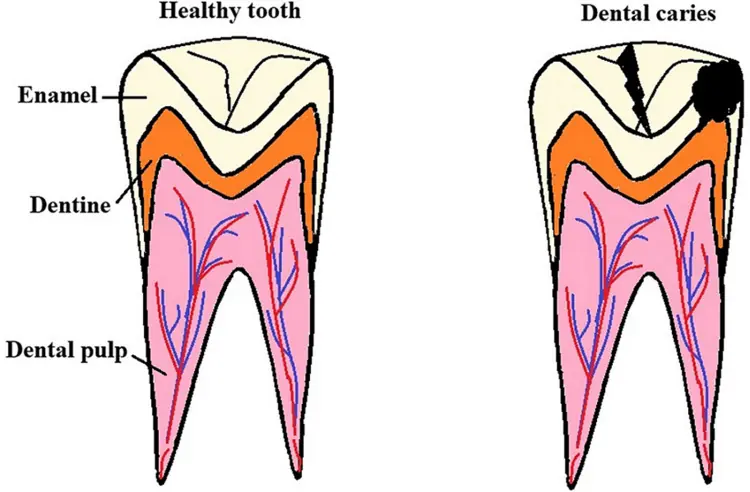
The development of dental caries is closely linked to the long-term accumulation of oral biofilms and the creation of an acidic environment resulting from sugar metabolism. When cariogenic microorganisms form stable biofilms on tooth surfaces and utilize fermentable carbohydrates to produce organic acids, the local pH at the tooth surface can drop, thereby increasing the risk of enamel mineral dissolution. Consequently, inhibiting the formation of cariogenic biofilms and reducing acid production are key areas of research for preventing dental caries.
Studies have shown that Galla chinensis and its constituents exert an inhibitory effect on oral bacteria, including Streptococcus mutans. The addition of Galla chinensis extract helps maintain a higher pH level within the biofilm system, reduces bacterial colonization on hydroxyapatite surfaces, and decreases the extent of enamel demineralization. These findings suggest that Galla chinensis extract may simultaneously influence bacterial colonization, biofilm formation, and the acid-generating environment, thereby reducing cariogenicity under experimental conditions.
Inhibiting Enamel Demineralization
Enamel is one of the hardest tissues in the human body, and its primary inorganic component is related to hydroxyapatite. When the oral environment maintains a consistently low pH, minerals within the enamel may gradually leach out-a process known as demineralization. The dynamic balance between demineralization and remineralization is a crucial factor in the early development of dental caries.
Researchers have found that treatment with Galla chinensis reduces mineral loss and the depth of caries-like lesions in enamel under experimental conditions, indicating a potential to inhibit demineralization. Notably, studies do not suggest that the anti-demineralization capability of Galla chinensis can fully replace that of fluoride. Research has also shown that different extraction methods result in varying compositions of active ingredients, with extracts containing higher tannin levels demonstrating superior anti-demineralization potential.
Promoting Tooth Remineralization
In addition to reducing mineral loss, dental research focuses on how to facilitate the re-acquisition of minerals by enamel that has already undergone early-stage demineralization-a process known as remineralization. Researchers have used artificially induced early enamel caries lesions to observe the effects of Galla chinensis extract on the enamel surface within a cyclic demineralization/remineralization environment. Findings indicate that Galla chinensis treatment alters mineral deposition and crystal structure on the enamel surface.
In one study, new mineral deposits appeared on the enamel surface following Galla chinensis treatment; the primary mineral remained hydroxyapatite, although changes in crystal structure were observed. Based on this, researchers suggest that Galla chinensis may regulate the remineralization process by influencing mineral ion deposition on the enamel surface.
Another study further revealed that in enamel models retaining their natural organic matrix, Galla chinensis increased surface microhardness; however, this effect was significantly diminished when the organic matrix was removed. This suggests that the organic matrix within the enamel may play a role in the process by which Galla chinensis promotes the remineralization of early caries lesions.
Galla Chinensis Extract vs. Gallic Acid vs. Tannic Acid
Galla chinensis extract is a complex botanical extract derived from Galla chinensis (Chinese nutgall) raw material; it may contain gallic acid, gallotannins, and other polyphenolic constituents. Gallic acid is a monomeric phenolic acid with a defined chemical structure, whereas tannic acid belongs to the class of tannins characterized by a polyphenolic structure. Consequently, these three substances may differ in terms of composition, molecular structure, analytical specifications, and their interactions with dental hard tissues and oral microorganisms.
For purchasers of oral care ingredients, if the objective is to develop oral care products based on Galla chinensis, it is essential to clarify whether the product requires a standard botanical extract, an extract standardized for total tannins, an extract with high gallic acid content, or a specific gallotannin component.
Galla Chinensis for Teeth: Potential Oral Care Uses

Toothpaste
Toothpaste represents one of the most noteworthy areas of application. Research has already been conducted on incorporating active ingredients from Galla chinensis directly into toothpaste to evaluate their effects on dentin hypersensitivity and the occlusion of dentinal tubules. This demonstrates that the study of Galla chinensis has moved beyond the stage of in vitro chemical experiments and into the formulation of practical oral care products.
Mouthwash
Given the existing research foundation regarding the effects of Galla chinensis extract on oral bacteria and biofilms, it serves as a promising plant-derived functional ingredient for developing mouthwash formulations designed for oral cleansing and microbial control. However, the efficacy of the final product must be validated through testing of the complete formulation; clinical performance cannot be inferred solely from in vitro antimicrobial results of the raw material.
Oral Sprays and Gels
Compared to toothpaste, these products may involve different oral contact times and release mechanisms. Consequently, specific studies are required to assess factors such as solubility, stability, pH, sensory characteristics, and compatibility with other formulation ingredients.
Galla Chinensis for Teeth: Is It Safe?
Current research on Galla chinensis covers areas such as antimicrobial activity, anti-caries effects, inhibition of demineralization, remineralization, and toxicological evaluation. Systematic reviews indicate that, as Galla chinensis is a complex botanical material containing a multitude of compounds, its biological activity likely arises from synergistic or antagonistic interactions among various constituents; consequently, it is difficult to attribute its full range of effects to any single component, and further refinement of safety and efficacy assessments is required.
Notably, relevant studies have reported no adverse reactions or side effects associated with the experimental toothpastes tested. These findings provide some support for the safety of short-term use under specific formulation conditions. However, should Galla chinensis extract be incorporated into commercial oral care products, further evaluations regarding safety, stability, and formulation-tailored to the final product format, concentration, duration of exposure, and target market regulations-would still be necessary.
How to Choose Galla Chinensis Extract?
Based on current scientific evidence, it is most accurate to classify Galla Chinensis as a functional, plant-derived raw material with research potential in areas such as anti-caries activity, enamel protection, dentin care, and oral microbiome control. Overseas developers of oral care products and raw material purchasers should evaluate key product details-such as the raw material source, extraction process, active ingredient specifications, and analytical methods-when selecting a manufacturer or supplier of Galla Chinensis extract.

KINTAIBIO® offers Galla Chinensis extract powders with tannic acid content ranging from 60% to 98%, and supports customization based on client requirements regarding active ingredient levels, particle size, and end-use applications. We provide services including sample testing, bulk procurement, OEM/ODM, and custom specifications for clients in the oral care, nutritional health, and other plant extract sectors. We also supply COAs, MSDS/SDS, product specification sheets, and batch quality documentation with orders.

If you are developing products containing Galla Chinensis, please contact sales@kintaibio.com to obtain samples, specifications, and purchasing information for our Galla Chinensis extract powder.
FAQ
Q: Is Galla chinensis good for teeth?
A: Current research indicates that Galla chinensis holds potential for dental and oral care applications. Its effects are primarily associated with antibacterial activity, biofilm control, the inhibition of enamel demineralization, remineralization, and the occlusion of dentinal tubules. Based on existing evidence, Galla chinensis is best suited for further research and formulation development as a potential oral care ingredient. However, results from in vitro experiments cannot be directly equated to clinical efficacy in humans. Individuals suffering from cavities, pulpal pain, or other dental conditions should still seek diagnosis and treatment from a professional dentist.
Q: Does Galla chinensis contain tannins?
A: Yes, tannins are among the key characteristic constituents of Galla chinensis. It is rich in hydrolyzable tannins-specifically gallotannins-as well as gallic acid and other polyphenolic compounds. Variations in raw materials and extraction processes result in differing proportions of tannins, gallic acid, and other polyphenols in the final extract. A major reason tannins have attracted interest in dental research is their strong protein-binding capacity, which allows them to interact with organic matrices such as the collagen found in dentin.
Q: Is Galla chinensis a substitute for fluoride?
A: At present, Galla chinensis cannot simply be regarded as a direct substitute for fluoride. Fluoride is backed by a robust body of research and extensive clinical application regarding caries prevention, whereas current evidence for Galla chinensis stems primarily from in vitro studies, experimental dental models, and a limited number of clinical trials. Consequently, the two differ significantly in terms of their evidence base and clinical track record. Research suggests that Galla chinensis may function by inhibiting certain cariogenic bacteria and biofilms, reducing enamel demineralization, and influencing remineralization processes. While it shows potential as an adjunct oral care ingredient or a raw material for non-fluoride oral care research, there is currently insufficient evidence to prove it can completely replace fluoride.