



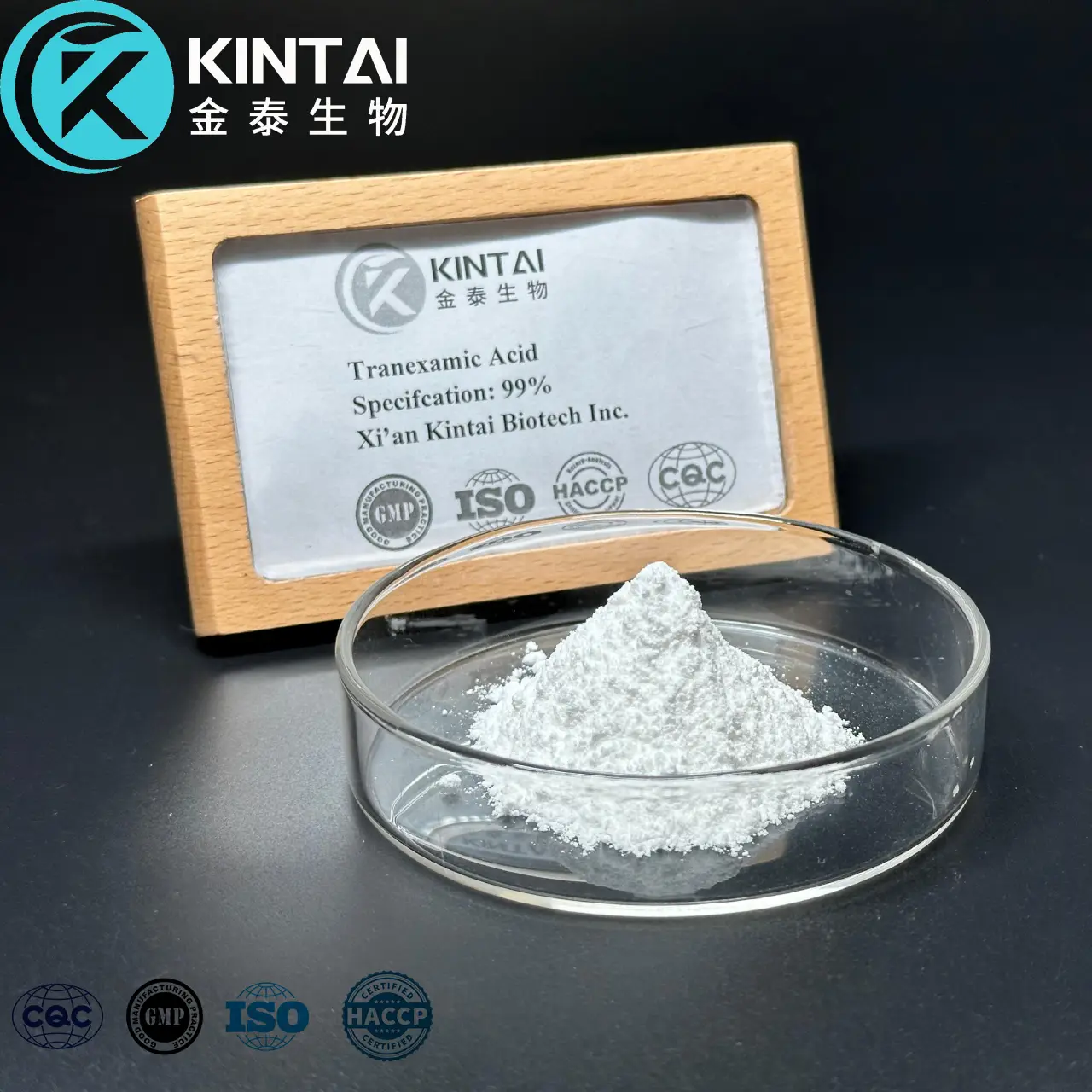
Xi'an Kintai Biotech Inc is one of the most experienced manufacturers and suppliers of tranexamic acid powder in China. Please feel free to wholesale high quality tranexamic acid powder for sale here from our factory. For price consultation, contact us.
tranexamic acid powder
KINTAIBIO® specializes in the production and supply of high-quality tranexamic acid powder. Regarding product specifications, we offer high-purity 99% tranexamic acid powder., with its content verified through analytical methods such as HPLC, meeting the needs of cosmetic and R&D clients. We have established a full-process quality control system spanning from raw material screening and synthesis to finished product delivery, ensuring that each batch meets industry standards for purity, solubility, and stability. If you are looking for a stable supplier of reliable, high-quality tranexamic acid powder, please contact us at pharm@kintaibio.com.

Tranexamic acid, also known as clotting acid or hemostatic cyclohexanecarboxylic acid, is a synthetically produced lysine derivative. It is a white crystalline powder, highly soluble in water, with a pH of approximately 7 to 8 (neutral to slightly alkaline), and is minimally irritating. Although the name contains 'acid',it is not a true acid but rather a slightly alkaline compound. It was initially used clinically as a hemostatic drug; later research discovered its significant effect in inhibiting melanin production. It can interfere with the signal transduction between melanocytes and keratinocytes, thereby reducing pigmentation. Owing to this property, tranexamic acid powder has gradually become widely used in skincare products, emerging as one of the important active ingredients in whitening and spot-fading products.
How to make tranexamic acid powder

Benefits of Tranexamic Acid
tranexamic acid powder for bleeding
a. Traumatic Bleeding
In the context of traumatic bleeding, there is substantial evidence for tranexamic acid. Studies show that tranexamic acid can reduce surgical blood loss by about one-third; when administered within 3 hours after bleeding occurs, it can also significantly reduce the risk of death caused by bleeding. This effect has been verified in various clinical scenarios such as cardiac surgery, orthopedic surgery, and liver surgery. Intravenous injection of tranexamic acid can effectively reduce intraoperative bleeding and subsequent blood transfusion requirements. In trauma care, early use of tranexamic acid has likewise been proven to reduce bleeding-related mortality, and multiple meta-analyses have not shown a significant increase in the risk of thromboembolic events. Based on current evidence, the benefits of tranexamic acid in the treatment of traumatic bleeding are clear, with a good safety profile, making it an indispensable and important drug in clinical hemostatic therapy.

b. Menorrhagia
Regarding menorrhagia, tranexamic acid represents one of the most mature applications in gynecology. A Cochrane systematic review including 13 randomized controlled trials with a total of 1,312 participants showed that, compared with placebo, tranexamic acid reduced average menstrual blood loss by 53.20 mL per cycle (95% CI: -62.70 to -43.70), with a significantly improved improvement rate (RR 3.34). Compared with progestogens, tranexamic acid has an advantage in improvement rate (RR 1.54) and fewer adverse events (RR 0.66); compared with NSAIDs, tranexamic acid also performs better in reducing blood loss. The FDA-approved treatment regimen for menorrhagia is: 3,900 mg daily during menstruation for up to 5 days. A 2022 Cochrane meta-analysis further confirmed that tranexamic acid can reduce blood loss by 40% to 50% per cycle and improve health-related quality of life and labor participation rates.
tranexamic acid powder for skin
In dermatological applications, the effects of tranexamic acid stem from its multiple pharmacological properties: inhibiting melanin production, anti-inflammatory, and anti-angiogenic.

Melasma is the most closely watched application area for tranexamic acid in dermatology. Multiple studies on oral tranexamic acid for melasma show: a study of 74 women reported an overall improvement rate of 95.9%; topical tranexamic acid is also effective, with 2% topical tranexamic acid used continuously for 12 weeks significantly improving melasma; combined use with microneedling or fractional CO₂ laser can further enhance transdermal delivery efficiency and improve efficacy. Regarding acne and post-inflammatory hyperpigmentation, a randomized double-blind placebo-controlled study showed that 10% tranexamic acid serum can significantly reduce inflammatory acne lesion counts and improve post-acne erythema and post-inflammatory hyperpigmentation; intradermal injection of tranexamic acid also shows significant improvement for persistent post-acne erythema. Regarding rosacea, based on its anti-inflammatory and anti-angiogenic properties, tranexamic acid is used for the treatment of erythematotelangiectatic rosacea. Topical tranexamic acid combined with microneedling can improve all patients, and the clinical improvement from intradermal microinjection can last up to 3 months after treatment.
Uses of Tranexamic Acid Powder
Clinical Medicine with tranexamic acid
In the medical field, tranexamic acid acts as an antifibrinolytic agent, stabilizing blood clots by inhibiting fibrinolysis, thereby reducing bleeding. In obstetrics and gynecology, it is used to treat menorrhagia and postpartum hemorrhage. In surgical procedures, it is used in cardiac, orthopedic (such as joint replacement), prostate, and bladder surgeries, among others, to reduce intraoperative and postoperative bleeding and blood transfusion needs. In trauma emergency care, use within 3 hours after trauma can reduce mortality caused by bleeding, and it has been incorporated into multiple emergency guidelines. In addition, it is used for epistaxis, gingival bleeding (tooth extraction in patients with coagulation disorders), gastrointestinal bleeding, urinary system bleeding, and other bleeding conditions. For hereditary angioedema, it can also be used to treat and prevent attacks of the disease.
skincare products with tranexamic acid
Owing to its multiple pharmacological properties-inhibiting melanin production, anti-inflammatory, and anti-angiogenic-tranexamic acid is widely used in the skincare field primarily as a mild whitening and spot-fading ingredient, especially suitable for people who want to improve uneven skin tone, acne marks, or melasma. The added concentration in skincare products typically ranges from 0.5% to 3%, with the effective concentration in most products on the market concentrated at 2% to 3%. This concentration ensures whitening efficacy while also taking mildness into account.

In practical use, tranexamic acid is often combined with other ingredients to enhance effects. For example, combining it with niacinamide and kojic acid can achieve multi-pathway whitening; synergistic use with vitamin C can more comprehensively brighten skin tone. However, it is generally not recommended to layer tranexamic acid simultaneously with highly irritating ingredients such as fruit acids, retinol, or salicylic acid, to avoid increasing skin burden. If a stronger spot-fading effect is desired, oral tranexamic acid has shown superior performance compared with topical use in clinical studies, but this falls under the category of prescription drugs and must be used strictly under medical guidance.
Safety and Side Effects of tranexamic acid Powder
Safety: In both medical and skincare fields, whether taken internally or applied topically, overall safety is relatively high.
Side effects: The incidence of adverse reactions from topical tranexamic acid in skincare is low and usually mild. Situations reported in clinical studies include: local burning or stinging, redness or erythema, dryness, and desquamation. Common adverse reactions of topical tranexamic acid in treating melasma are 'mild and transient'. In the medical field, the core use of tranexamic acid (tranexamic acid) is hemostasis, and it is a prescription drug. The most important concern is the risk of thrombosis. It is contraindicated in patients with active intravascular coagulation, a history of thrombosis, or risk factors for thrombosis, and must be used under a doctor's guidance. There are no clinical trial data for use of this product in pregnant women.
tranexamic acid powder suppliers
If you need to procure stable and reliable tranexamic acid powder, KINTAIBIO® can provide high-quality tranexamic acid with verified origin for global customers. Whether you need small tranexamic acid samples or long-term wholesale tranexamic acid powder orders, we can provide tailored supply solutions that flexibly meet the needs of each stage, from sample testing to large-scale production.

We can provide a full set of documents: COA, MSDS, test reports, and batch quality records. Purchasers looking for a stable supply channel can source directly from us. We will provide competitive tranexamic acid powder quotations based on different order volumes and delivery requirements. Welcome to contact us at pharm@kintaibio.com.

FAQ
Q: Does tranexamic acid irritate the skin?
A: Although the name contains "acid," tranexamic acid is not a true acid but a slightly alkaline compound, with a pH of approximately 7 to 8 (neutral to slightly alkaline), and is minimally irritating. In skincare products, its added concentration typically ranges from 0.5% to 3%, with the effective concentration in most products concentrated at 2% to 3%, ensuring whitening efficacy while also taking mildness into account. However, it is still not recommended to layer it simultaneously with highly irritating ingredients such as fruit acids, retinol, or salicylic acid, to avoid increasing skin burden.
Q: Does tranexamic acid lighten your skin?
A: Tranexamic acid can brighten the skin, particularly by fading dark spots, melasma, and post-inflammatory hyperpigmentation, rather than bleaching the entire skin tone. It works through multiple pharmacological properties, including inhibiting melanin production, anti-inflammatory, and anti-angiogenic effects, interfering with the signal transduction between melanocytes and keratinocytes, thereby reducing pigmentation. In the skincare field, it is widely used primarily as a mild whitening and spot-fading ingredient. Clinical studies show that oral tranexamic acid is also significantly effective in treating melasma. If a stronger spot-fading effect is desired, oral tranexamic acid has shown superior performance compared with topical use in clinical studies, but this falls under the category of prescription drugs and must be used strictly under medical guidance.
Q: Can tranexamic acid be used long-term?
A: The overall safety of topical tranexamic acid in skincare is relatively high, with a low incidence of adverse reactions that are usually mild and transient; therefore, at compliant concentrations, it can be used long-term for daily skincare. However, if persistent burning, redness, or desquamation occurs during use, use should be suspended and a professional consulted. If oral tranexamic acid is involved, it falls under the category of prescription drugs and must be used under a doctor's guidance according to the treatment course, and should not be taken long-term on one's own. Particular attention should be paid to the risk of thrombosis: it is contraindicated in patients with active intravascular coagulation, a history of thrombosis, or risk factors for thrombosis. If symptoms suggestive of thrombosis such as blurred vision, headache, chest pain, or lower limb swelling occur during use, the medication should be stopped immediately and medical attention sought.
Hot Tags: tranexamic acid powder, China tranexamic acid powder manufacturers, suppliers, factory, Beta Arbutin Powder, Chicory Extract Powder, GHK Cu Powder, Hydrolyzed Keratin Powder, Pennywort Extract, α-Arbutin powder


