

Dihydroquercetin, a striking flavonoid compound, has received widespread attention from the scientific community in recent years due to its unique properties and rich sources. This article will explore the source of dihydroquercetin, its historical background, and how it has gained an important position in the field of medicine and health products.

Sources of dihydroquercetin
1. Natural sources
Dihydroquercetin is mainly derived from plants in the pine family, especially larch. This tree grows at high altitudes in cold regions such as Siberia and can survive extreme conditions where temperatures drop to -50 degrees Celsius. In order to resist cold and oxidative stress, larch produces dihydroquercetin to help protect its cells from freezing damage.

Other common sources of dihydroquercetin include:
Onions (Allium cepa): Onions are a well-known dietary source rich in dihydroquercetin.
Citrus fruits: Such as oranges and lemons, these fruits are also rich in flavonoids.
Pine trees: Many pine trees, especially those in North America, can also extract this valuable compound.

2. Extraction method
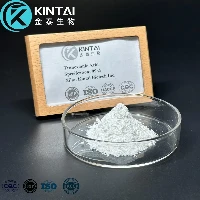
There are many ways to extract dihydroquercetin, including alcohol extraction, water extraction and supercritical fluid extraction. These methods can effectively separate dihydroquercetin while retaining its biological activity as much as possible. The quality of the extraction process directly affects the quality of the final product, so it is crucial for the industrial production of health products and drugs. Kintai is currently the largest dihydroquercetin production plant in Russia. Their factory is located in Xi'an, China, the origin of plant extracts. Their raw materials come from larch in the Changbai Mountain area of China. Using sawdust as raw material, they extract dihydroquercetin with a content of more than 99%, which is sold well in domestic and foreign markets.

Historical background
1. Early discovery
The history of dihydroquercetin can be traced back to the 1930s. In 1936, Hungarian scientists first discovered this flavonoid compound. They identified the existence of dihydroquercetin while studying the antioxidant properties of plant compounds. Scientists have found that it can enhance the strength of capillaries and help normalize the permeability of capillaries, so it is classified as a type of vitamin P.
2. Scientific progress
With the in-depth study of flavonoid compounds, the medical value of dihydroquercetin has gradually attracted attention. In the 1960s, scientists began to conduct large-scale research on it, and 56 international authoritative institutions around the world have systematically studied it. This series of studies not only promoted the understanding of dihydroquercetin, but also laid the foundation for its potential medical applications.
3. Commercial development
In 2006, Russian researchers used unique natural resources to successfully extract dihydroquercetin from the roots of Siberian larch, marking the beginning of the industrialization process of this compound in drug production. This important development has led to the inclusion of dihydroquercetin in the pharmacopoeia, and it is clearly recorded as a bioflavonoid compound in the Russian pharmacopoeia. Its pharmacological properties have attracted widespread attention in the medical community.
Characteristics of dihydroquercetin
1. Chemical structure
The chemical structure of dihydroquercetin is complex and belongs to the flavonoid family. Its molecular formula is C15H12O7 and its molecular weight is 304.25 g/mol. The structure consists of two benzene rings (ring A and ring B) connected by an oxygen-containing ring C. The 3-hydroxyl group on the C ring is connected to the carbon 2 of the B ring, giving it strong biological activity.

2. Biological activity
Studies have shown that dihydroquercetin has a variety of biological activities, including antioxidant, anti-inflammatory, and vascular protection. It can inhibit the lipid oxidation process of cell membranes and reduce the damage of free radicals to cells, thereby delaying cell aging.
In addition, dihydroquercetin has shown good cell protection in a variety of experiments, especially in its ability to fight oxidative stress and reduce inflammatory responses. These characteristics have made it a focus of attention in medical research and health product development.

Therefore, it has been used in high-end health products, skin care raw materials, and pharmaceutical intermediates.
Culture and Legends
There is also a beautiful legend about the origin of dihydroquercetin. In ancient Siberian culture, people believed that there was a beautiful ice goddess who was in charge of the ice and cold in winter. In order to keep her territory full of vitality in the cold winter, the goddess gave larch a magical ability to produce dihydroquercetin. This substance not only allows trees to survive in extreme cold, but also keeps the entire forest green and full of vitality in winter.
Modern Applications
Today, dihydroquercetin has become a precious natural extract, widely used in medicine, health products and cosmetics. With the deepening of understanding of its pharmacological properties, more and more studies are focused on exploring the potential application of dihydroquercetin in disease management, especially in anti-inflammatory, antioxidant and immunomodulatory effects.
The story of dihydroquercetin is not only a magical phenomenon in nature, but also a process of continuous exploration and discovery by scientists. From early identification to modern industrial production, dihydroquercetin demonstrates the wisdom of nature and the resilience of life. As an important natural compound, the potential of dihydroquercetin in promoting health and preventing diseases is still being explored. In the future, as more research is carried out, dihydroquercetin is expected to play an even more important role in medicine and health care. If you would like to know more about this product, please contact us at sales@kintaibio.com | WhatsApp: +86-181 8259 4708