

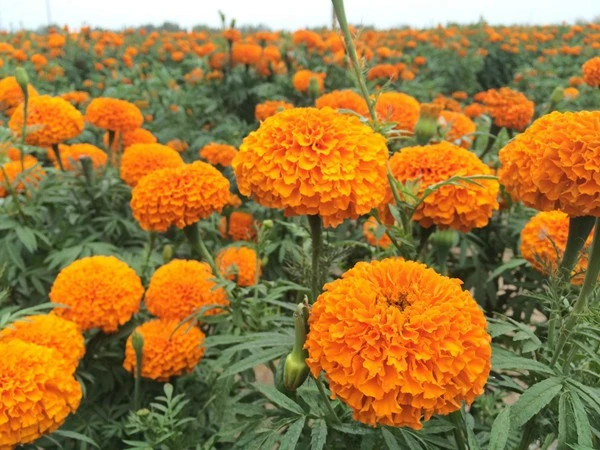
Tagetes erecta L is an annual herb in the family Asteraceae, with erect, stout, longitudinal and thin ribs, and branches flattened upwards. Native to Mexico, it is distributed throughout China, mostly in roadside meadows. Marigolds are often sown in the spring and are often used in flower bed settings because of their large flowers and long flowering period.
Historical origins
In the 16th century, marigold was still called petaled chrysanthemum because its flowers and leaves had a smell of stinky green, and people called it casually. Because of a later anecdote, marigold has its current name.Legend has it that more than 500 years ago, a Spanish officer went to Mexico and occasionally found wildflowers of marigold in the suburbs, which he thought was very cute and brought the seeds back to Europe. Many people saw it blooming all golden flowers and enshrined it in front of the image of the Virgin Mary. In English, it is named Mary is Gold, which means "Golden Mary".By the middle of the 16th century, it first spread to South China, when its name was unknown. Because its flowers and leaves have a smell of stinky green, it has to be casually called "petal stinky chrysanthemum".
Ingredients and values
Marigold is rich in lutein. Lutein is a natural pigment widely found in vegetables, flowers, fruits and certain algae organisms, and is found in food coloring, cosmetics, tobacco, medicine and poultry feed.Lutein is an excellent antioxidant with strong stability, no toxic side effects and high safety.As a food additive, lutein can resist cell and organ damage caused by free radicals in the human body, thereby preventing cardiovascular sclerosis, coronary heart disease and tumor diseases caused by aging.
The United States has been extracting lutein from marigold since the 70s of the 20th century, which was first added to chicken feed to improve the nutritional value of eggs. Lutein can also be used in cosmetics, feed, medicine, aquatic products and other industries. On the international market, the price of 1 gram of lutein is comparable to 1 gram of gold.
Efficacy of each part
Root: The external use of the root of this plant has a good therapeutic effect on mastitis, mumps and other diseases, and internal use can treat toothache, stomatitis, pharyngitis, keratitis, bronchitis, pertussis, upper respiratory tract infection and other symptoms;
Leaves: The leaves of this plant can treat nameless swelling and poison, and are often used to treat boils, boils, sores and other symptoms;
Inflorescence: The inflorescence of this plant can be used to treat symptoms such as gills, breast pain, cough, cold cough, pediatric shock, headache and eye pain, dizziness and other symptoms;
Flowers: Its flowers can dissolve phlegm and relieve cough, clear heat and detoxify, etc., and can also be made into antispasmodics, sedatives, bacteriostatic agents, etc