





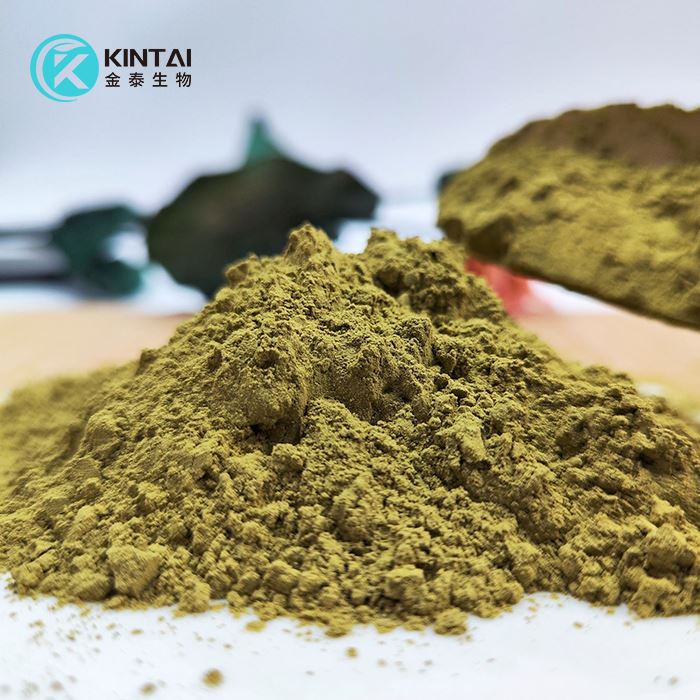

Xi'an Kintai Biotech Inc is one of the most experienced manufacturers and suppliers of corosolic acid powder in China. Please feel free to wholesale high quality corosolic acid powder for sale here from our factory. For price consultation, contact us.
corosolic acid powder supplier/manufacturer
As a professional manufacturer of corosolic acid powder, KINTAIBIO® provides you with high-quality corosolic acid, a plant-based active ingredient. Corosolic acid is primarily derived from the dried leaves of the loquat tree (Eriobotrya japonica), a member of the Rosaceae family, and is also found in other natural plants such as Lagerstroemia indica, Scutellaria baicalensis, Smilax china, and Perilla frutescens. Studies have confirmed that corosolic acid can stimulate glucose transport, promoting cellular absorption and utilization of glucose, thus exerting a significant hypoglycemic effect. Its mechanism of action is similar to insulin, hence its nickname "plant insulin."
Corosolic acid extracted from loquat leaves also possesses multiple pharmacological activities, including aiding weight loss, anti-tumor activity, and anti-inflammatory effects. Our company supplies corosolic acid powder in a complete range of specifications, with standard contents of 10%, 20%, and 80%, etc. We also accept customized specifications to meet the needs of different application scenarios. The product sourcing is clearly traceable; we strictly select authentic dried loquat leaves as raw materials and employ advanced modern extraction and purification processes to ensure high purity and batch stability of the active ingredients.

Our corosolic acid powder has several advantages: First, after optimized processing, the content of active ingredients is significantly higher than that of similar extracts, resulting in higher bioavailability; second, a strict quality management system is implemented throughout the entire process, with strict controls at every stage from raw material intake to finished product delivery to ensure safety, purity, and activity; third, the product has been widely used in the market and has gained consistent recognition from customers, and can play a targeted role as "plant insulin" in hypoglycemic compound preparations or single products.
Why should you choose KINTAIBIO®?

corosolic acid powder nature sources
KINTAIBIO®'s corosolic acid powder is primarily derived from loquat leaves or Banaba leaves. Loquat leaves, from the loquat tree (a member of the Rosaceae family), yield a higher concentration of active ingredients compared to crape myrtle leaves. Our carefully selected loquat leaves are sourced from a clearly defined origin and can be harvested year-round. We typically use hydrophilic organic solvents (such as ethanol) for reflux extraction, followed by enrichment and purification with macroporous adsorption resins to obtain corosolic acid powders of varying purities. For more product information, please contact us at sales@kintaibio.com.


COA of Corosolic Acid Powder

Determination Of Corosolic Acid In Loquat Leaves By RP-HPLC
Reagents and samples
Corosolic acid standard (purity 95%), methanol (chromatographically pure), twice distilled water, glacial acetic acid, ethanol (fractional
analysis pure).
The loquat leaf sample was collected from Shexian County, Anhui Province, and was identified as a Dahongpao variety by local agricultural technicians.
Chromatographic conditions
Chromatographic column: Phenom enex -C18, 5μm, 250 mm × 4.6 mm i.d.; column temperature: 27 ℃; mobile phase: methanol-1.0% acetic acid aqueous solution (88∶12 by volume); detection wavelength: 215 nm; flow rate
0.8mL/min; sampling method: automatic sampling. Injection volume: 10μL.
Preparation of standard solution
Put the Corosolic Acid Powder standard in an oven and dry at 105 °C to constant weight. Accurately weigh 10.0mg of corosolic acid standard substance, place it in a 10.0mL volumetric flask, dissolve it with methanol sonication, and make it to volume.
Sample preparation
Dry the fresh loquat leaves to constant weight, crush them, and pass through a 60-mesh sieve. Take 2.0g of loquat leaf powder, add 20mL of 90% ethanol solution, extract at 90°C for 3h, and extract 3 times in total. After natural cooling, the obtained
Combine the extracts and dilute them to 100 mL with a 90% ethanol solution. Concentrate 20.0 mL of the extract to 5.0 mL, add 40.0 mL of twice distilled water to filter, dry the precipitate, dissolve it in methanol, and dilute to 25.0mL, spare.

Figure 1 (a) corosolic acid standard, (b) corosolic acid extraction solution, and (c) chromatograms of the extract after water precipitation

Figure 2 (a) Mass spectrum of corosolic acid standard and (b) corosolic acid in loquat leaf samples
How to make corosolic acid powder?

Raw Material Pretreatment and Removal of Water-Soluble Impurities
Using dried loquat leaves (or other plants containing corosolic acid such as Lagerstroemia indica) as raw material, pulverize to 20-40 mesh. Add pure water (solid-to-liquid ratio 1:8-1:12), boil for 1-2 hours, discard the aqueous phase, and remove water-soluble impurities such as polysaccharides and tannins, retaining the solid residue.
Alkaline Organic Solvent Extraction of Total Triterpenic Acids
Add 30%-60% alkaline ethanol or methanol aqueous solution (pH 9-11) to the residue, at a solid-to-liquid ratio of 1:6-1:10, and extract by stirring at 50-60℃ for 1.5-2 hours, repeating twice. Combine the extracts, filter to remove residue, then adjust the pH to 4.5-7.5 (typical value 5.0-6.0) with dilute hydrochloric acid or dilute sulfuric acid, allow to stand for precipitation for 1-2 hours, centrifuge or filter plate and frame to obtain crude total triterpenic acid product.
Crude Product Dissolution and Macroporous Adsorption Resin Purification
The crude total triterpenic acid product is completely dissolved in 85%–100% ethanol or methanol (95% ethanol is commonly used), and insoluble matter is removed by filtration. The clarified filtrate is passed through a macroporous adsorption resin column for adsorption. Polar impurities are first washed away with a low concentration of ethanol (30%–50%), followed by elution of corosolic acid with a high concentration of ethanol (70%–90%). The eluent rich in corosolic acid is collected.
Crystallization Separation and Drying
The final concentration of ethanol or methanol in the eluent is adjusted to ≤50%, and the pH is adjusted to ≤7.0. The mixture is allowed to stand at low temperature for 12–24 hours, during which corosolic acid crystals precipitate. These crystals are separated by centrifugation or vacuum filtration to obtain wet crystals. The wet crystals are dried under vacuum (temperature ≤60℃, vacuum degree ≤-0.08 MPa), pulverized, and sieved to obtain corosolic acid powder. The finished product is packaged and stored after passing HPLC testing, and third-party professional testing is supported.
what is corosolic acid good for?

corosolic acid for weight loss
Studies have revealed that corosolic acid exerts a comprehensive regulatory effect on obesity-induced metabolic disorders by activating the AMPK signaling pathway, inhibiting inflammatory responses in adipose tissue, and improving insulin resistance. Laboratory studies have also confirmed that corosolic acid can increase GLP-1 and leptin levels, promoting weight loss by regulating appetite and energy metabolism.
Human clinical studies also support its weight-loss effects. Data show that taking corosolic acid leads to a significant weight-loss trend, with a relatively gradual process that does not require additional dieting. In summary, the weight-loss effect of corosolic acid powder is not simply about reducing weight, but rather achieved by improving adipose tissue dysfunction and regulating metabolic signaling pathways. This characteristic gives it unique value in weight management and metabolic health supplement formulations.
corosolic acid for blood sugar
Corosolic acid (CA), a natural triterpenoid compound, and its derivatives target MCCC1 to counteract insulin resistance and lower blood glucose levels in type 2 diabetic mice. CA promotes cellular glucose uptake and utilization by stimulating glucose transport. Through quantitative proteomics analysis, researchers discovered for the first time that corosolic acid can directly bind to the biotin-containing enzyme methylcrotonyl-CoA carboxylase 1 (MCCC1). Its mechanism of action in treating type 2 diabetes (T2DM) primarily focuses on the insulin resistance signaling pathway, particularly targeting MCCC1, thereby combating insulin resistance and improving glucose metabolism.
Meanwhile, to overcome the limitations of corosolic acid powder, such as high in vitro toxicity, low water solubility, and poor pharmacokinetic properties, researchers synthesized a series of derivatives and screened compound H26. H26 maintains a significant hypoglycemic effect while exhibiting lower toxicity and superior pharmacokinetic characteristics, demonstrating great potential as a hypoglycemic drug.


corosolic acid for anti-inflammatory
Numerous studies have demonstrated that corosolic acid possesses multiple activities, including anti-inflammatory, anti-metabolic syndrome, lipid-lowering, and antiviral effects. Its anti-inflammatory effects are not only manifested in the inhibition of pro-inflammatory cytokines and inflammatory signaling pathways, but are also closely related to metabolic diseases such as obesity and diabetes.
Notably, with the increasing proportion of obese and diabetic individuals, the incidence of non-alcoholic fatty liver disease (NAFLD) continues to rise. NAFLD itself is often accompanied by chronic low-grade inflammation and is prone to progressing to hepatocellular carcinoma (HCC). Research has found that corosolic acid powder can effectively inhibit the progression of NAFLD and exert its anti-inflammatory effects through multi-target activity, even showing synergistic effects when used in combination with chemotherapeutic drugs in drug-resistant cells.
Reference:https://www.sciencedirect.com/science/article/abs/pii/S0944711316000064
https://www.sciencedirect.com/science/article/abs/pii/S0223523424010663
https://pmc.ncbi.nlm.nih.gov/articles/PMC7723172/
corosolic acid uses


Currently, this natural product is marketed as a dietary supplement in the United States, and Phase III clinical trials for its use as an adjunct treatment for diabetes are also underway. Although the FDA has not yet certified it as a therapeutic drug, this process demonstrates its broad potential as a functional health ingredient. Compared to insulin injections, oral corosolic acid powder is more easily absorbed and utilized, and is expected to show considerable potential in assisting blood sugar management, with natural ingredients having lower toxicity and side effects.
Corosolic acid supplements have become a core component of our product portfolio. Banaba leaf extract supplement not only possesses the characteristics of "plant insulin" but also helps maintain healthy blood sugar levels. Our corosolic acid powder also meets the growing global demand for diabetes and metabolic health supplements.
corosolic acid side effects,dosage,safety
corosolic acid dosage
Regarding safety, existing studies show that corosolic acid has a good safety record at conventional doses. Toxicological evaluations further confirm that corosolic acid has good safety at therapeutic doses; in animal acute toxicity experiments, no lethal effects occurred even at oral doses up to 2,000 mg/kg. Based on comprehensive modern clinical trials and toxicological data, the safety of corosolic acid, as a naturally derived plant-based active ingredient, for long-term use within the recommended dosage range has been sufficiently validated.

corosolic acid side effects
- However, it should be noted that corosolic acid has a blood sugar-lowering effect. Individuals taking hypoglycemic drugs (such as insulin, metformin, etc.) who wish to use products containing corosolic acid are advised to monitor their blood sugar levels to prevent the risk of hypoglycemia.
- Caution should be exercised when using corosolic acid in patients with renal insufficiency. There are reported cases of acute kidney injury and lactic acidosis in patients with impaired renal function after taking corosolic acid powder.
- Furthermore, safety data for pregnant women, breastfeeding women, and children are insufficient. It is recommended to use this product under the guidance of a physician or nutritionist to ensure safe and standardized application.
where to buy Corosolic Acid powder?
As a leading manufacturer of loquat leaf extract in China, KINTAIBIO® has cultivated a strong reputation in the corosolic acid market for over a decade, specializing in loquat leaf extract products. We offer a full range of corosolic acid powder (10%, 20% and other customized specifications), support third-party professional testing, and provide complete Certificate of Analysis (COA) reports, ensuring reliable quality.

Our products are widely used in health foods, dietary supplements, and functional foods, particularly excelling in formulations for aiding in blood sugar control and metabolic regulation. Choosing KINTAIBIO® means receiving affordable, high-quality corosolic acid powder, along with comprehensive support from technical consultation to application development. Please contact us online at sales@kintaibio.com; we look forward to establishing a long-term, stable partnership with you.

Hot Tags: Corosolic Acid Powder, China Corosolic Acid Powder manufacturers, suppliers, factory, Wheatgrass Extract Powder, Agastache Rugosa Extract, Corosolic Acid Powder, Pterostilbene Powder, Solgar Siberian Ginseng Root Extract, Cortex Phellodendri Extract


