



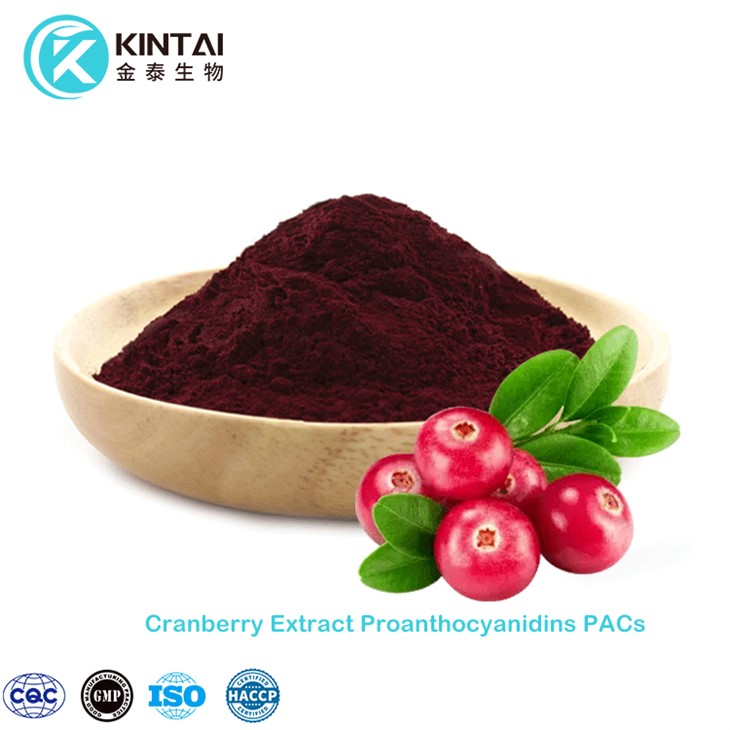
Xi'an Kintai Biotech Inc is one of the most experienced manufacturers and suppliers of cranberry extract pac powder in China. Please feel free to wholesale high quality cranberry extract pac powder for sale here from our factory. For price consultation, contact us.
1. Cranberry Extract Powder manufacturers
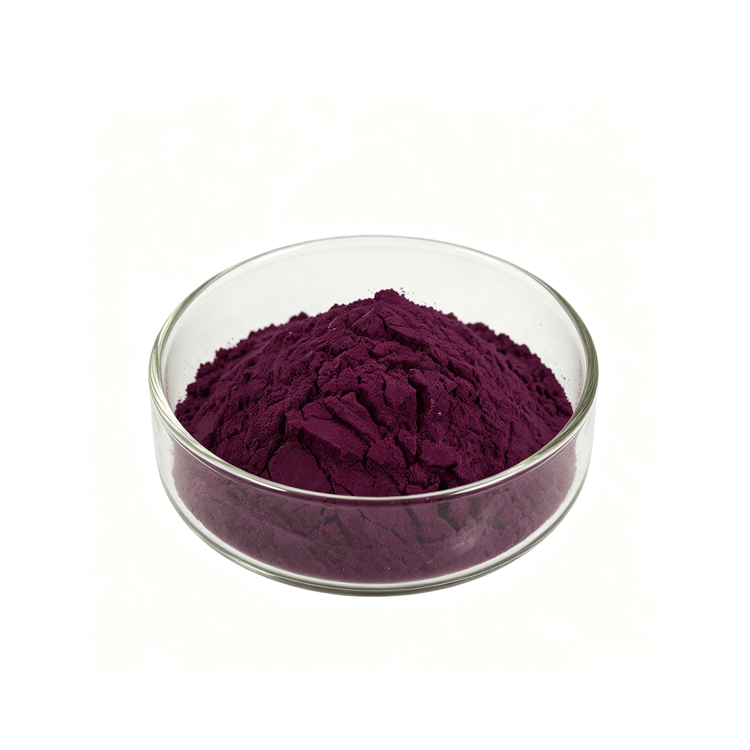
Kintaibio's Cranberry Extract Powder is a deep-red, fine powder refined from the mature berries of Vaccinium macrocarpon L. (a plant in the Vaccinium genus of the Ericaceae family) through processes including ethanol extraction, adsorption resin column chromatography, and spray drying. The fruit is rich in various active compounds, such as proanthocyanidins (PACs), anthocyanins, flavonols, phenolic acids, and organic acids; notably, A-type PACs are the key functional components that distinguish cranberry-derived PACs from the B-type PACs found in sources like grape seeds, apples, and green tea.
As the main cranberry extract powder suppliers in china. we offer cranberry fruit powder extract wholesale is a deep-red, free-flowing fine powder that is 100% water-soluble, dissolving completely within two minutes. It is suitable for a wide range of applications, including dietary supplements, functional foods, beverages, cosmetics, and pet nutrition products.
In 2004, the French Food Safety Agency (AFSSA, now ANSES) approved a health claim for cranberries, stating that cranberry products containing 36 mg of proanthocyanidins "help reduce the adhesion of certain E. coli bacteria to the urinary tract walls." On May 12, 2017, the EFSA Panel on Dietetic Products, Nutrition and Allergies (NDA Panel) issued a scientific opinion (EFSA Journal 2017;15(5):4777) concluding that cranberry extract powder is safe for use as a food ingredient at the proposed levels and methods of consumption.
Consequently, cranberry extract proanthocyanidins pac powder can be used as a functional food ingredient-added to items such as beverages and yogurt-and is intended for the general adult population.
2. Cranberry Extract proanthocyanidins PAC Powder Technical Specification
We offer a comprehensive product line of cranberry extracts with proanthocyanidin contents ranging from 1% to 50%, spanning the full spectrum from entry-level fruit juice powders to high-purity extracts. These products are suitable for diverse applications, including dietary supplements, functional foods, beverages, cosmetics, and pharmaceutical raw materials. Products are standardized and graded based on various testing methods-such as UV spectrophotometry, the EP (European Pharmacopoeia) method, BL-DMAC spectrophotometry, and the β-Smith (n-butanol/HCl) method-each of which relies on different principles and is suited to specific applications; these methods are detailed individually below.
2.1 Detailed of Detection Methods
2.1.1 UV Spectrophotometry
This method is based on the reaction of proanthocyanidins with specific chromogenic agents (such as the vanillin-hydrochloric acid system or iron salt reagents) to form colored complexes. Absorbance is measured at a specific wavelength (typically 500–550 nm), and the total proanthocyanidin content is calculated by comparing the result against a standard curve. This method reflects the overall level of total polyphenolic substances in the sample.
Characteristics:
- Simple operation, low cost, and high throughput; suitable for industrial-scale batch testing.
- Wide detection range; applicable to specifications with contents of 1%–50% or even higher.
- Relatively low specificity; susceptible to interference from other polyphenolic substances (e.g., anthocyanins, flavonols).
- Results are typically expressed as "Total Proanthocyanidins (UV)."
- Applicable specifications: Proanthocyanidins 1%–50% (UV).
2.1.2 EP Method (European Pharmacopoeia Method)
Principle: Quantitative analysis of proanthocyanidins is performed using specific chromogenic systems and reference standards, in accordance with the method for proanthocyanidin determination included in the *European Pharmacopoeia* (EP 5.0).
Proanthocyanidins are inherently colorless compounds; however, under treatment with hot acid (n-butanol-hydrochloric acid), the polymer chains undergo acid hydrolysis, cleaving to release deep-red anthocyanidin ions. These anthocyanidin ions exhibit characteristic absorption in the visible light region; by measuring absorbance at a specific wavelength using a spectrophotometer, the proanthocyanidin content in the sample can be quantitatively determined.
Characteristics:
- The EP 5.0 method for proanthocyanidin determination is widely used for the quality control of various botanical drugs-such as Hawthorn (Crataegus), Bilberry/Blueberry (Vaccinium), and Ginkgo (Ginkgo biloba)-and their extracts. It is characterized by broad applicability, high accuracy, and good repeatability and reproducibility. Complies with EU pharmaceutical-grade quality standards.
- The methodology has been systematically validated by the European Pharmacopoeia Commission, ensuring its authority and regulatory acceptance.
- Suitable for pharmaceutical- and dietary supplement-grade products destined for the EU market.
- Results are internationally recognized.
Applicable specifications: Proanthocyanidins 5% and 25% (EP 5.0 method).
Note: The total proanthocyanidin content determined by the EP method is at least 50% higher than that determined by the DMACA method. This discrepancy arises from the differing detection principles of the two methods: the EP method relies on color development from anthocyanidin ions following acid hydrolysis, thereby measuring total proanthocyanidins (including polymers), whereas the DMACA method primarily detects soluble oligomers. Each method has a distinct focus and they complement one another.
2.1.3 BL-DMAC Spectrophotometry (4-Dimethylaminocinnamaldehyde Method)
The BL-DMAC method utilizes 4-dimethylaminocinnamaldehyde (DMAC) as the chromogenic reagent. Under acidic conditions, DMAC undergoes a specific condensation reaction with the phloroglucinol A-ring of proanthocyanidin (PAC) molecules, yielding a blue compound with maximum absorbance at 640 nm. By measuring absorbance at 640 nm, the content of soluble proanthocyanidins in the sample can be quantitatively determined. Other flavonoid compounds do not participate in this reaction; consequently, the method demonstrates significantly superior selectivity for flavanols compared to the traditional UV method.
Features:
- Offers better selectivity for flavan-3-ols compared to UV-based methods and is less susceptible to interference from other polyphenols.
- Currently a widely accepted method in the pharmaceutical and food industries for quantifying PACs.
- Using a 96-well plate reader and a cranberry PAC (c-PAC) reference standard with the DMAC method significantly improves accuracy and precision, eliminating the need for complex equipment like HPLC.
- The DMAC method has received AOAC (Association of Official Agricultural Chemists) "First Action" official method status (Method No. 2019.06).
- Reference standards: Procyanidin A2 (ProA2) dimer or c-PAC (cranberry) standards can be used.
Important Note: The BL-DMAC method cannot distinguish between A-type and B-type PACs. Therefore, when using the DMAC method, it is essential to combine it with species identification of the raw material source (e.g., via HPLC fingerprinting or HPTLC) to ensure the product is genuinely derived from cranberries rather than cheaper plant sources. Notably, the AOAC has also approved the MALDI-TOF MS (Matrix-Assisted Laser Desorption/Ionization Time-of-Flight Mass Spectrometry) method for identifying A-type PACs. The DMAC method quantifies soluble PACs, while the MALDI-TOF MS method identifies A-type PACs; together, they form a comprehensive testing suite covering both quantification and qualitative identification.
Applicable specifications: Proanthocyanidins 1%, 8%, 10%, 15% (BL-DMAC).
Another existing testing method is the OSC-DMAC method. Fundamentally, it is the same DMAC colorimetric assay (utilizing the exact same chemical reaction as BL-DMAC); the only difference lies in the reference standard used for calculation. The BL-DMAC method uses the Procyanidin A2 dimer as the reference standard, whereas the OSC-DMAC method uses a purified mixture of cranberry PACs (c-PAC).
Since the reference standard for the OSC-DMAC method consists of a mixture of various oligomeric and polymeric PACs found in cranberries, the results provide a more comprehensive reflection of the total PAC levels (including both oligomers and polymers) in the sample.
2.1.4 Bate-Smith Method (n-Butanol-HCl Method)
Principle: Under conditions of strong acidity (hydrochloric acid) and heating, proanthocyanidin polymer chains undergo acid hydrolysis, releasing red anthocyanidins (primarily cyanidin). The proanthocyanidin content can be calculated indirectly by measuring absorbance at 550 nm.
Characteristics:
- Better suited for determining proanthocyanidins with a high degree of polymerization (polymers)
- Shows a weaker response to oligomeric proanthocyanidins
- Involves harsh reaction conditions (acid hydrolysis with heating) and requires rigorous operational procedures
- Complements the DMAC method-the DMAC method is more suitable for the quantification of soluble oligomeric PACs
This method may be selected as a supplementary test for certain PAC products with a high degree of polymerization.
3. Cranberry Extract proanthocyanidins PAC Powder Specifications
Our company offers the following full range of Cranberry Extract Powder lines:
3.1 By Proanthocyanidin (PAC) Content Grade
| Specification | Test Method | Content Range | Typical Applications |
|---|---|---|---|
| PAC 1%–50% | UV | 1%, 5%, 10%, 15%, 20%, 25%, 30%, 40%, 50% | General‑grade dietary supplements, functional foods |
| PAC 5%–40% | EP (European Pharmacopoeia 5.0) | 5%, 25% | Pharmaceutical‑grade and dietary supplements for EU market |
| PAC 5%–30% | BL‑DMAC | 5%, 10%, 15%, 30% | Standardised dietary supplements |
3.2 By Extraction Ratio Grade
| Specification | Description | Typical Applications |
|---|---|---|
| Cranberry Fruit Powder | Directly milled whole fruit, retains natural nutrients | Natural foods, solid beverages |
| 5:1 Extract | 5‑fold concentrated | Routine dietary supplements |
| 10:1 Extract | 10‑fold concentrated | Mid‑to‑high‑strength finished products |
| 20:1 Extract | 20‑fold concentrated | High‑strength capsules, tablets |
| 100:1 Extract | 100‑fold concentrated | Ultra‑high‑strength formulations |
3.3 cranberry extract vs juice powder differences
Extract removes sugars and water, concentrating active substances tens of times; concentrated juice is closer to natural juice but has higher sugar intake.
3.4 Quality Assurance
- Botanical identification: 100% Vaccinium macrocarpon L. origin, verified by HPLC chromatographic fingerprinting and HPTLC.
- Third‑party testing: Upon request, we can commission internationally recognised institutions for identity (ID) verification.
- Contaminant control: PAHs (polycyclic aromatic hydrocarbons), heavy metals (As, Pb, Cd, Hg), microorganisms (total plate count, moulds, yeasts), and pesticide residues all comply with international standards.
- Clean label commitment: Non‑irradiated, Non‑GMO, Non‑allergen.
4. Cranberry Extract proanthocyanidins PAC Powder Production Process
Cranberry Concentrate Juice
↓
Ethanol Extraction
↓
Adsorption Resin Column Chromatography
(Selectively retains phenolic compounds while removing approx. 90% of sugars and organic acids)
↓
Elution
↓
Concentration
↓
Addition of Maltodextrin (carrier) + Silicon Dioxide (flow aid)
↓
Spray Drying
↓
Packaging
(Double‑layer polyethylene bags + fibre drums, with desiccant included)
5. cranberry extract powder benefits
5.1 Urinary Tract Health
Cranberry‑derived A‑type proanthocyanidins (PACs) are distinguished by their unique flavan‑3‑ol structure, which contains at least one A‑type interflavan bond (a double linkage) and is primarily composed of oligomers and polymers of epicatechin and epigallocatechin. This specific configuration endows them with a biological activity not found in B‑type PACs from other plant sources: the ability to inhibit the adhesion of type‑1 and P‑fimbriated E. coli to the urothelial mucosa, thereby reducing bacterial colonisation and the recurrence of urinary tract infections. In addition, their anti‑inflammatory properties help suppress symptomatic flares and limit the intracellular spread of bacteria-an effect particularly relevant for chronic or relapsing cystitis, including interstitial cystitis. Through this dual mechanism (anti‑adhesion and anti‑inflammation), cranberry A‑type PACs offer a targeted approach to maintaining urinary tract health.
These benefits are not limited to humans. In veterinary practice, cranberry extract powder for dogs and cranberry extract for cats are increasingly used as supportive measures for lower urinary tract disorders. For dogs, cranberry extract for dogs UTI and cranberry extract for cats UTI are common applications, and many commercial dog cranberry extract products are standardised to ensure reliable PAC content. Some premium cat food with cranberry extract now includes this ingredient as a proactive component. When using such supplements, cranberry extract for dogs dosage should be based on body weight – typically 2–5 mg PAC per pound. Pet owners often ask: is cranberry extract safe for dogs? The answer is yes, provided the product contains no xylitol or grape derivatives and is given at appropriate levels.
5.2 Antioxidant & Anti‑Aging Effects
As a natural antioxidant, Cranberry Extract PAC possess an Oxygen Radical Absorbance Capacity (ORAC) that is 3‑ to 7‑fold higher than that of many common antioxidants. This enables efficient scavenging of reactive oxygen species and mitigation of oxidative cellular damage. In skincare and oral nutricosmetics, they are increasingly valued as a gentle alternative to retinol, offering collagen‑supporting benefits without the irritation or photosensitivity often associated with vitamin A derivatives. Regular intake can improve skin texture, reduce fine lines, and promote a more even complexion by counteracting UV‑induced oxidative stress.
5.3 Digestive & Immune Modulation
Cranberry extract also exhibits antimicrobial activity against Helicobacter pylori, interfering with its urease activity and gastric colonisation, which supports a healthier stomach environment. It is frequently combined with probiotics – especially Lactobacillus and Bifidobacterium strains – to create a synergistic effect: the PACs reduce pathogenic load while the probiotics restore beneficial flora. This combination is particularly beneficial for cranberry extract for women, as it helps maintain both intestinal and vaginal microbiome balance, reducing the recurrence of yeast infections. Similarly, cranberry extract for men can support gastrointestinal health and overall immune resilience, especially when used alongside a fibre‑rich diet.
5.4 Neuroprotective Potential
Emerging research indicates that cranberry PACs may offer neuroprotective effects beyond their peripheral antioxidant activity. In preclinical models of Alzheimer's disease, a cranberry extract standardised to 4.0 % PACs has shown significant protection against amyloid‑β‑induced neurotoxicity, reducing oxidative neuronal damage and modulating microglial inflammatory responses. These findings suggest a potential role in slowing cognitive decline and supporting memory function in ageing populations, warranting further clinical exploration.
5. Cranberry Extract proanthocyanidins PAC Powder Recommendations for End‑Product Development
Our Cranberry Extract is supplied as a powder. After purchase, it can be developed into liquids, softgels, tablets, capsules, gummies, and instant sachets (ready‑to‑mix drinks).
It is suitable for:
- Women – for the prevention of UTIs and maintenance of vaginal health;
- Men – for prostate support and overall urinary tract health;
- Specialised pet formulations – for dogs and cats, often used to relieve urinary crystals and bladder discomfort caused by stress or bacterial issues (strict dosage control is required).
- For pregnancy and lactation: Although whole cranberry foods are generally recognised as safe, consultation with a healthcare professional is recommended before taking concentrated cranberry extract supplements during pregnancy.
| Development Direction | Recommended Dosage per Serving | Target Population | Market Positioning |
|---|---|---|---|
| Women's urinary health beverage | 150 mg (80 mg PACs) | Adult women | Prevention of recurrent UTIs; alternative to antibiotic regimens |
| Daily antioxidant functional drink | 150 mg (80 mg PACs) | Adults aged 18–55 | Natural antioxidant with high ORAC value |
| Sports recovery beverage | 150 mg (80 mg PACs) | Active individuals | Anti‑inflammatory + mucosal repair |
| Functional yoghurt / dairy drink | 150 mg (per 125 g yoghurt) | General adult population | Dual health benefits: gut + urinary tract |
| Oral beauty drink | 75–150 mg | Female consumers | Anti‑glycation + anti‑aging |
6. Cranberry Extract proanthocyanidins PAC Powder Recommended Dosage and Formulation Suggestions
EFSA-Recognised Use
Cranberry Extract Powder is intended for addition to the following food categories, providing 80 mg PACs per serving (calculated as total PACs, including both oligomers and polymers):
| Food Category | Amount of this product added (mg/serving) |
Serving Size (mL or g) |
Addition Ratio (%) | End-use Claim Direction |
|---|---|---|---|---|
| Fruit-flavoured beverages (regular/low-calorie) | 150 | 250 | 0.06 | Urinary tract health / daily antioxidant |
| Isotonic sports drinks (with electrolytes) | 150 | 250 | 0.06 | Post-exercise recovery + mucosal health |
| Ready-to-drink (RTD) tea / iced tea | 150 | 250 | 0.06 | Natural polyphenol supplementation |
| Vitamin-fortified water | 150 | 330 | 0.045 | Daily nutritional fortification |
| Yoghurt | 150 | 125 | 0.12 | Functional dairy |
| Drinking yoghurt | 150 | 200 | 0.075 | Ready-to-drink functional beverage |
Reference intake: The average daily Cranberry Extract proanthocyanidins PAC Powder intake for adults is 68–74 mg (95th percentile of users approx. 192–219 mg/day). Compared to commercially available 27% cranberry juice (average 156 mg PACs/240 mL), the PAC concentration of this product after addition is at an equivalent or lower level, ensuring a strong safety profile.
For daily wellness and UTI prevention in humans: A daily intake of 36 mg to 72 mg of standardised PACs is generally recommended, equivalent to approximately 400 mg to 500 mg of extract powder, taken 1–2 times daily.
For dogs and cats: Dosage should be calculated based on body weight (typically 10–20 mg per kg of body weight). Pet-specific extracts (e.g., Nutramax Crananidin) must strictly avoid human excipients such as xylitol.
Note: Although generally safe, patients taking anticoagulants such as Warfarin should exercise caution, as high-dose extracts may potentiate the drug's effect and increase bleeding risk.
7. Cranberry Extract proanthocyanidins PAC Powder Production and Processing Recommendations
Processing tolerance: Validated for over 22 weeks of stability in beverage systems; withstands conventional UHT and pasteurisation processes.
Formulation compatibility: Cranberry Extract Powder Can be compounded with vitamin C, prebiotics, electrolytes, and other ingredients, with no known antagonistic reactions. A single extract has limited efficacy; mainstream market products often use composite formulations to enhance bioavailability:
- D‑Mannose Synergistic effect with PACs, dual‑mechanism blockade of bacterial adhesion; currently the most popular UTI prevention combination.
- Vitamin C Acidifies urine, creating an environment unfavourable for bacterial growth.
- Probiotics Maintain gut and vaginal flora balance, boosting endogenous immunity.
- Potassium Magnesium Citrate Alkalinises urine, prevents mineral crystallisation, reducing stone risk (commonly found in premium liquid sachets).
- Astragalus Often used in kidney support formulas, synergistically protects renal function.
8. Where to Buy bulk Cranberry Extract Powder?
Our Company's pure Cranberry Extract Products are manufactured from high-quality North American cranberries (Vaccinium macrocarpon L.) as the raw material, offering a full range of specifications with proanthocyanidin (PAC) content from 1% to 50%. Relying on a cross‑verification system that integrates four analytical methods – UV, EP (European Pharmacopoeia), BL‑DMAC, and β‑Smith – we ensure the accuracy and standardisation of product content. Whether you are a dietary supplement brand, a functional food manufacturer, or a purchaser of cosmetic raw materials, you will find the most suitable specification solution within our product portfolio.

If you are interested in purchasing high-quality China Cranberry Extract Powder, please feel free to contact us at sales@kintaibio.com or submit your feedback on the next page.

Frequently Asked Questions from Manufacturers
Q1: What is the difference between your OSC‑DMAC 50% specification and the 25% PAC (UV) offered by other suppliers?
A1: The test methods and reference standards are different, so direct comparisons are not valid. The OSC‑DMAC method uses cranberry‑specific PACs as the reference standard, offering higher specificity, whereas the UV method measures total polyphenols and is susceptible to interference from other phenolic compounds.
Q2: Can this product be used in children's foods?
A2: Under the EFSA recognition, this product is not intended for infants, toddlers, or individuals under 19 years of age; the target population is the general adult population. We recommend that end‑product labels state "for adult consumption."
Q3: How does this product differ from grape seed extract proanthocyanidins?
A3: Cranberries contain A‑type proanthocyanidins (with A‑type flavan‑3‑ol interflavan bonds), which exhibit bacterial anti‑adhesion activity. Grape seed extract contains B‑type proanthocyanidins and does not possess this function. The two have fundamental differences in chemical structure, biological activity, and application scenarios, and they are not interchangeable.
Q4: How can we claim efficacy on our end‑products?
A4: As a food ingredient, efficacy claims for cranberry extract must comply with the regulations of each sales region (e.g., EFSA health claims regulation in the EU, FDA structure/function claims in the US, and China's GB 7718 and health food regulations). This product provides a safe, compliant, and standardised functional ingredient; for specific claim wording, please consult a local regulatory advisor.
Q5: How can the antioxidant capacity of this product be quantified?
A5: The oxygen radical absorbance capacity (ORAC) of proanthocyanidins can be 3‑ to 7‑fold higher than that of common antioxidants such as vitamin C and vitamin E. This product has a total phenolic content >46.2%, demonstrating excellent antioxidant activity.
Q6: Is there any safety concern with long‑term intake of polyphenols?
A6: The EFSA assessment confirms that, at the proposed use levels (adult average daily PAC intake of 68–74 mg), this product presents no nutritional disadvantage. In clinical trials, subjects consuming 36–72 mg PACs per day for several consecutive weeks showed no safety issues. Cranberries have a long history of consumption; adverse effects are primarily gastrointestinal and are more commonly seen with long‑term, high‑volume juice consumption.
9. Quality Commitment – Your Most Reliable Supply Chain Guarantee
Compliance commitment: 100% compliant with EFSA novel food specifications.
Batch‑to‑batch consistency: Validated over three or more batches, with key parameters such as heavy metals, PACs, and total phenolics remaining stable.
Clean label: Non‑GMO, non‑irradiated, allergen‑free, and no artificial additives.
Third‑party testing support: Upon request, we can commission internationally recognised laboratories to perform identity (ID) authentication and potency verification.
Please feel free to contact sales@kintaibio for more product information and technical documents.
Hot Tags: cranberry extract pac powder, China cranberry extract pac powder manufacturers, suppliers, factory, Bulk Powder Omega 3, Schisandra Berry Extract Powder, Tribulus Terrestris Extract Powder


